
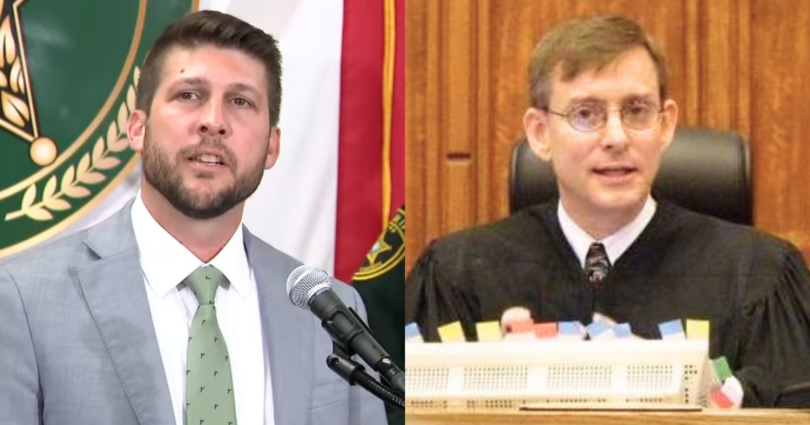
Uthmeier Calls for Impeachment of Miami Judge Over Insanity Acquittal in Child Homicide
Florida Attorney General James Uthmeier is moving to impeach a Miami-Dade judge following an insanity acquittal in a child homicide case, turning a courtroom outcome into a broader political dispute over judicial authority and criminal accountability in Florida.
Uthmeier’s effort targets Miami-Dade Circuit Judge Miguel de la O, who found 43-year-old Precious Bland not guilty by reason of insanity in a bench trial tied to the 2021 death of a 15-month-old child and the stabbing of two family members.
The ruling has drawn strong criticism from state officials who argue it raises serious questions about how Florida courts are applying the insanity standard in cases involving extreme violence.
“This was a bench trial. It’s time to impeach this judge,” Uthmeier wrote on X, saying his office will draft articles of impeachment and work with state lawmakers to pursue removal.
The underlying case involved allegations that Bland killed her young daughter and attacked two relatives during a severe mental health episode in which she expressed delusional religious beliefs tied to COVID-era fears, including claims that her family needed to be baptized to avoid death, according to Local 10.
Defense attorneys countered with expert testimony arguing Bland was experiencing a profound psychotic break, marked by hallucinations and a distorted perception of reality that left her unable to understand the nature or consequences of her actions, the Tampa Bay Times reported.
Due to Bland waiving her right to a jury trial, Judge de la O acted as the sole fact-finder, evaluating both the evidence and the legal standard for insanity under Florida law.
He ultimately concluded that Bland met that threshold, determining she lacked the capacity to understand what she was doing at the time of the incident. That finding removed criminal liability but did not end court oversight of the case.
Bland remains under judicial supervision while the court determines whether she will be committed to a state mental health facility or placed under conditional release with treatment requirements.
Uthmeier’s response reframed the outcome as more than a case-specific legal determination, arguing instead that it reflects a broader institutional concern about how judicial discretion is being applied in violent crime cases involving severe mental illness.
His impeachment push signals an effort to move the dispute out of the appellate system and into the political arena, where judges can face removal through legislative action.
The announcement is notable because impeachment proceedings against judges in Florida are rare and require approval from the state legislature.
In practice, judicial decisions in criminal cases are typically challenged through appeals rather than direct political action, making Uthmeier’s move an unusual escalation in response to a verdict.
Supporters of the ruling argue that Florida’s insanity standard exists specifically to address cases involving severe psychiatric impairment and that judicial findings in bench trials are a routine and lawful part of the criminal justice system.
From that perspective, the judge’s role was to apply established legal criteria to expert testimony and determine whether the defendant met the statutory threshold.
Critics, however, argue that high-profile violent cases involving children place extraordinary pressure on courts and intensify public scrutiny of outcomes that may be legally sound but politically volatile.
The disagreement highlights an ongoing tension between legal standards for mental illness defenses and public expectations in cases involving extreme harm.
The controversy also underscores the significance of bench trials in cases of this nature.
Unlike jury trials, bench trials place full responsibility for factual and legal determinations on a single judge, concentrating decision-making authority in cases that often carry heavy emotional and political consequences.
As the impeachment effort develops, the dispute is expected to expand beyond the specifics of Bland’s case into a broader debate over judicial independence, mental health defenses, and the limits of political accountability for courtroom rulings.
Whether Florida lawmakers advance any formal proceedings against the judge will determine whether the controversy remains rhetorical or evolves into a rare legislative challenge to judicial conduct.
Bland remains under court jurisdiction as the state determines her long-term treatment and supervision status.
WATCH:
Continue Scrolling for the Comments
Leave a Comment