
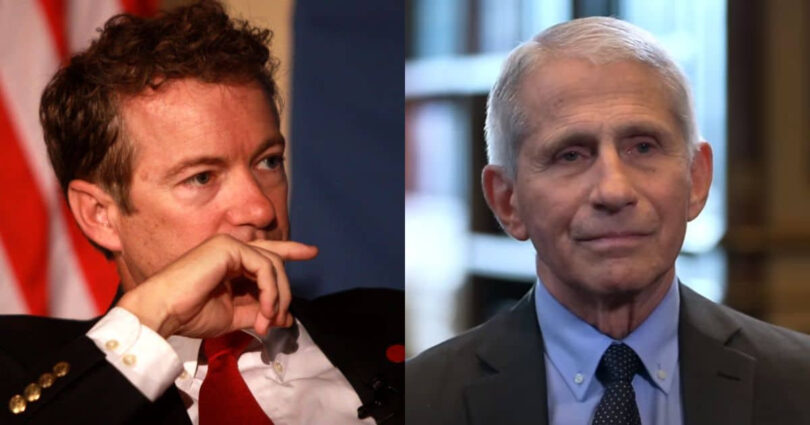
A reckoning years in the making landed on Dr. Anthony Fauci Thursday, as a Senate committee voted along party lines to hold the former government immunologist in contempt of Congress.
The vote capped a pursuit led by Sen. Rand Paul, R-Ky., who has spent years working to hold Fauci accountable for his role directing the nation’s COVID-19 pandemic response.
The trigger came just days earlier, when Fauci sat before the panel and invoked his Fifth Amendment right against self-incrimination 111 separate times during a single appearance.
Paul opened Thursday’s vote by rejecting any excuse for that silence, pointing out that Fauci had already secured a pardon from President Joe Biden before leaving office.
“All he had to do was tell the truth,” Paul said.
Paul framed the fight as bigger than one man, casting it as preparation for whatever health crisis comes next.
“There will be another pandemic. The time to determine which legislative reforms are necessary to make sure the mistakes of the past are not repeated is now, not later,” Paul said.
Not every member of the committee agreed with that framing. Sen. Gary Peters, D-Mich., accused Republicans of running a lopsided investigation designed to reach a predetermined outcome.
“This investigation has been one-sided from the beginning,” Peters said. “The minority has been excluded from witness interviews and full access to committee records and information has been selectively released to support conclusions that the chairman reached years ago.”
Paul has repeatedly denied that claim, placing the blame on Democrats themselves for declining to engage with the probe.
He has cited a committee-built website containing every piece of evidence gathered in the Fauci investigation, telling colleagues Tuesday that no Democrat had ever logged on to view it.
Fauci’s long career atop the National Institute of Allergy and Infectious Diseases ended with a preemptive pardon from Biden, issued in January 2025, that closed the door on federal charges against him.
That legal shield didn’t stop the backlash to his courtroom silence. Reaction poured in from voices well outside the Senate chamber, including podcast host Charlamagne Tha God, NFL quarterback Aaron Rodgers, and Philadelphia Eagles defensive coordinator Vic Fangio, all of whom criticized Fauci’s repeated use of the Fifth.
A presidential pardon only reaches so far, and it carries no weight against state prosecutors. Florida has already opened its own investigation into Fauci, and other states are exploring similar action.
Sen. Tommy Tuberville, R-Ala., signaled after the hearing that accountability doesn’t require a prison sentence to matter.
“If we can’t put him in prison, let’s put him in court every day for the rest of his life, where he has to be punished and listened to the death that he caused,” Tuberville said.
The contempt vote doesn’t guarantee prosecution. Senate Republicans are still sorting through the legal and procedural questions tied to a criminal contempt referral.
Paul told Fox News Digital Tuesday that he expects enough Senate votes to approve the referral, and he said he intends to route the matter straight to the Justice Department once that happens.
Sen. Josh Hawley, R-Mo., who previously served as a state attorney general, revealed his office is already drafting a memo aimed at Acting Attorney General Todd Blanche.
“My team is working right now on a memo to Blanche explaining why we think that he can be prosecuted for contempt of Congress,” Hawley told Fox News Digital.
Hawley zeroed in on what he sees as a legal contradiction in Fauci’s position, arguing a pardon and a Fifth Amendment claim can’t coexist.
“He’s not entitled to immunity, taking the Fifth, when he already has a pardon. It’s one or the other,” Hawley said.
Standard Senate procedure would send the committee’s contempt finding to the full chamber for a vote. Paul wants to skip that step.
His plan calls for Vice President JD Vance, acting in his constitutional capacity as president of the Senate, to certify the committee’s action without a full Senate vote.
From there, Vance would forward the referral directly to the U.S. Attorney for the District of Columbia, setting the stage for a possible criminal case built entirely outside the traditional legislative track.
The outcome now rests with prosecutors and the procedural path Republicans choose to take through the Senate and the Justice Department.
Continue Scrolling for the Comments
Leave a Comment