
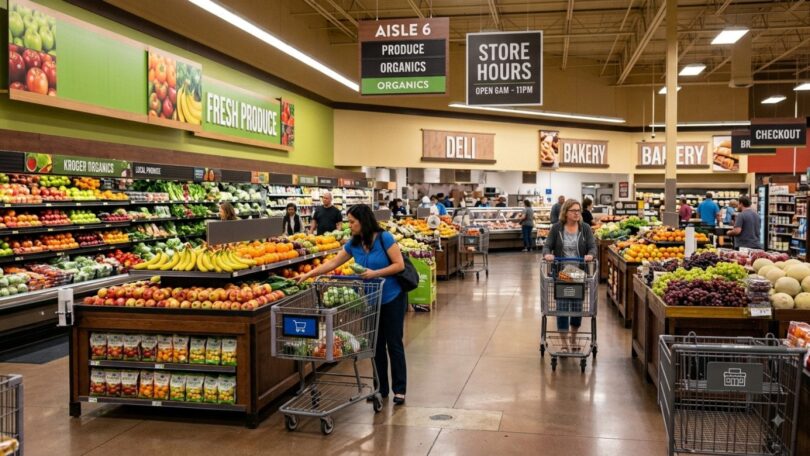
Your local Kroger may be in danger of closing.
A new report has revealed 39 Kroger supermarket stores some of which are identified under a different banner have closed its doors.
The closings won’t end there though.
Dozens more are set to close its doors by the end of 2026.
Fox Business was the first to break the story and provided insight on what led Kroger to make the tough call:
Kroger has closed at least three dozen stores since announcing plans last year to shutter 60 locations that were not “delivering sustainable results” by the end of 2026.
The Cincinnati-based grocery giant did not release a full list of stores or banners slated for closure, but online searches listed 39 locations across nine banners as no longer operating. Local reports also confirmed that many of the locations were part of the broader store overhaul.
As of January 2026, Kroger operated 2,697 supermarkets across 35 states under roughly 20 banners, including Fred Meyer, Fry’s Food and Drug, Harris Teeter, Jay C, King Soopers, Mariano’s, Pick ’n Save, QFC and Ralphs, according to a Securities and Exchange Commission filing.
The company said the closures are intended to help it “run more efficiently and ensure the long-term health of our business,” according to FOX 26 Houston, which reported that two Houston-area locations were slated to close in April.
The closures come as Kroger announced plans last month to acquire regional grocery chain Giant Eagle for $1.65 billion, which would add another 197 supermarkets and 11 standalone pharmacies across northern Ohio, western Pennsylvania, West Virginia, Maryland and Indiana.
Kroger in recent years has seemed more interested in selling shopper’s data than keeping their stores open.
WKYC reported more on Kroger cashing on its customer’s data:
Grocery store loyalty programs offer customers digital coupons, fuel discounts and product recall notifications in exchange for membership.
However, a Consumer Reports investigation has found that Kroger, one of the nation’s largest grocery chains, collects and monetizes shopper data on a scale that exceeds typical retail practices.According to the investigation, retail loyalty programs typically require customers to provide their name, home address, email address and phone number during signup. Store chains then track purchasing patterns to build customer profiles. While this practice is common across the industry, Consumer Reports found that Kroger has developed what it characterizes as a sophisticated data collection and analysis operation.
“Store chains often collect your name, home address, email address, and phone number. Then study what’s in your grocery cart. Many retailers do this, but Kroger, one of the largest grocery chains in the U.S., is doing it in a much bigger, profitable way,” said Derek Kravitz, an investigative reporter with Consumer Reports.
The investigation found that Kroger uses collected data both internally and sells it to third parties for targeted marketing purposes. The company’s precision marketing division generated an estimated $527 million last year. These alternative profit ventures now account for more than 35% of Kroger’s net income, according to Consumer Reports.
Watch Senator Josh Hawley expose Kroger:
Leave a Comment