
O’Keefe Exposes Revolting Loophole – It’s Not Good
A hidden-camera operation targeting Minnesota polling sites has surfaced footage in which election staff describe a mechanism allowing a single registered voter to stand in as identification for as many as eight other people on Election Day.
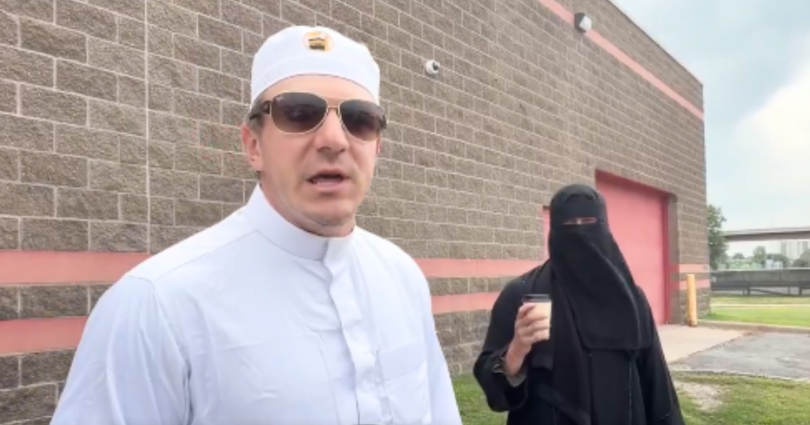
Conservative investigative journalist James O’Keefe published the recording Wednesday, an 11-minute compilation stitched together from visits to multiple Minneapolis voting locations.
The project, dubbed the Justice League investigation, paired O’Keefe with fellow undercover journalists Anthony Rubin of Real Muckraker and Cam Higby.
Rather than approach poll workers directly as himself, O’Keefe adopted a disguise, wearing traditional Muslim clothing while posing questions designed to test the outer limits of the system.
He described an exaggerated situation involving several people he claimed were unregistered and wanted to vote anyway.
The responses he received on camera form the core of the investigation.
One worker, when asked how many people a single registered voter could vouch for, gave a specific number without hesitation.
“If you’re all in the same precinct and you are already registered, you can vouch for them as ID. Eight people,” she said.
That answer prompted a follow-up from O’Keefe, who wanted to know what would substitute for a physical identification document.
The worker’s reply was direct: “You’re the ID.”
A separate exchange captured at another location shows a different staffer acknowledging, without prompting concern, that the people being discussed had no registration on file at all.
“I can vouch for them. They are not registered… That’s okay. That’s fine. Yeah!” the worker said.
Underpinning the entire exchange is Minnesota Statutes § 201.061, a state election law that permits registered voters to sign a legal affidavit vouching for another person’s residency in the same precinct.
The statute effectively opens a path to same-day registration that bypasses conventional proof-of-address requirements.
The investigation’s most detailed breakdown came from a worker stationed at the White Park Recreation Center.
That staffer laid out the two-step honor system built into the law: the voucher must personally know the person they’re vouching for and must be confident that individual actually lives in the precinct.
From there, the process relies entirely on sworn statements. The voucher signs an oath attesting to the other person’s residency.
The person being vouched for then signs a separate oath of their own, swearing to their identity and their eligibility to cast a ballot.
O’Keefe used the moment to ask a pointed question: is any of this checked against outside records? The worker’s answer was short and specific.
“After the fact, yeah,” she said, indicating that verification, if it happens, comes only after the ballot has already been submitted.
The footage does not present a uniform picture across every location visited.
Some poll workers reportedly grew skeptical of the undercover team mid-conversation and began asking their own questions about why the group wanted so much detail on the vouching procedure.
No footage or transcript from those more guarded exchanges was included in the portions of the video made public, leaving the full scope of that pushback undocumented in the released material.
The release lands squarely within an ongoing national debate over how states balance ballot access against verification standards, with Minnesota’s vouching statute long serving as a flashpoint in that argument.
Defenders of the vouching provision have historically framed it as a safety net for voters who lack standard documentation, including elderly residents and people facing unstable housing situations, ensuring they aren’t turned away from the polls.
O’Keefe’s team frames the newly released material as firsthand evidence of how that safety net functions in practice, built entirely from statements made directly by election workers on duty at active polling locations.
At publication, no Minnesota election office or state agency had issued a public response addressing the specific claims, quotes, or footage contained in the Justice League investigation.
Continue Scrolling for the Comments
Leave a Comment