
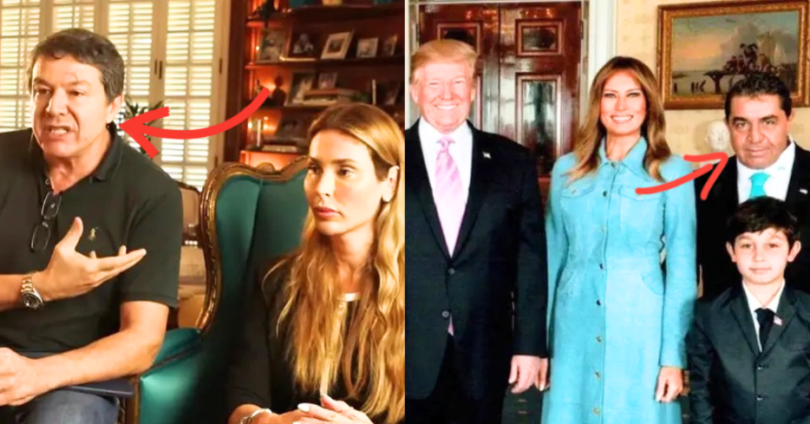
A Florida fugitive accused of butchering plastic surgery patients has ignited a fresh diplomatic firestorm by openly bragging that Brazilian government officials helped him vanish from the United States before his criminal trial.
Joao Araujo, 57, slipped out of Florida on August 1 by boat, eventually landing in Rio de Janeiro after a multi-leg journey through the Bahamas and Panama.
His candid remarks came during a sit-down with “The Bad Decisions Podcast,” hosted by Scott Michael Nathan, with excerpts released Saturday.
Florida prosecutors had charged Araujo with 14 crimes, including grand theft, fraud, and practicing medicine without a license.
Patients who sought his services say he left them permanently disfigured through mishandled fillers, liposuction, and laser treatments.
Rather than address those allegations, Araujo framed his flight as political retaliation, claiming friction with a State Department envoy and suggesting his wife’s knowledge of first lady Melania Trump made him a target.
His wife, Amanda Ungaro, is a former model with documented ties to Jeffrey Epstein.
Notably, the case against Araujo originated with a Democrat-controlled state prosecutor’s office in Florida — not federal authorities tied to the Trump administration he blamed.
Speaking to podcast host Nathan, Araujo dismissed the difficulty of his getaway. “Any idiot knows how to leave the United States. I had all the support of the Brazilian consulate,” he said.
A previously unreleased two-minute segment of the interview, shared with the New York Post by producer Hurrdat Entertainment, captured Araujo walking through the logistics of severing his ankle monitor and disappearing.
He credited an extensive network for his freedom.
“They are all my friends. Both the Brazilian federal police and the Brazilian embassy gave me all the support in Miami,” Araujo said, adding that he viewed the Florida detective investigating him as “an idiot.”
Pressed on specifics, Araujo detailed his exact escape route.
“When I decided to leave, I simply cut off the electronic ankle bracelet. I took [Interstate] 95. I took a boat owned by an acquaintance and went to [the island of] Bimini [in the Bahamas], [then to] Nassau, Panama, Rio de Janeiro,” he said.
He then filled in the timeline hour by hour.
“I left at 4:30 a.m. I arrived in [the island of] Bimini [in the Bahamas] early. From Bimini, I took a plane at 230 p.m. I arrived in Nassau 40 minutes later. Because the flight was fully booked to Panama, I had to spend the night,” he said.
Araujo credited his military background with helping him defeat the monitoring device meant to keep him confined.
“I was in the military so I tested this [ankle] monitor all the time to see its range. Several times I went to the airport. I would take Amanda’s bags and come back…. I could move anywhere in the radius. I couldn’t go past West Palm Beach,” he said.
During a separate conversation with Brazilian journalist Hildegarde Angel, Araujo went further, naming specific consular figures on a first-name basis — including Cristiano Berbert, the acting consul general in Miami, and his predecessor Andre Odenbreit Carvalho, who left the post in May.
He also referenced Marcelo Ivo, a former Brazilian Federal Police liaison stationed in Miami.
U.S. officials pushed Ivo out of his position in April as part of a tit-for-tat exchange after Brazil expelled an American official.
Brazil’s constitutional protections against extraditing native-born citizens mean Araujo faces little risk of ever standing trial on American soil.
Legal scholars warn the fallout could be severe if Araujo’s claims hold up.
George Washington University’s Jonathan Turley told the Post that consular involvement in a fugitive’s escape “would be a serious breach of diplomatic status” and could expose the officials involved to expulsion under international law.
William & Mary Law School’s Luz Nagle echoed those concerns, calling any confirmed complicity a violation of both American sovereignty and the Vienna Convention on Consular Relations.
Berea College’s Carlos Poggio cautioned that Araujo has reason to exaggerate his government connections for sympathetic audiences back home.
He also noted that the scandal erupts amid what he called the tensest stretch in US-Brazil relations in decades — a period already marked by steep tariffs, sanctions against a Brazilian justice, and dueling visa disputes tied to Brazil’s upcoming election.
Brazilian officials have largely stonewalled inquiries.
The Washington embassy said consular matters fall outside its scope, the Miami consulate stayed silent, and Brazil’s foreign ministry cited privacy law in declining to discuss Araujo’s passport or case specifics.
Paolo Zampolli, Trump’s envoy for global partnerships and the ex-boyfriend of Araujo’s wife, predicted Brazil would continue shielding the fugitive from extradition.
Both the State Department and Miami-Dade prosecutors declined immediate comment, with the State Department directing inquiries to the Justice Department.
Continue Scrolling for the Comments
Leave a Comment