
Without Saying How, Bill Gates Issues Doomsday Warning About Controversial Subject That Could ‘Cause a Billion Deaths’ Unless Humanity Takes His Advice
A political divide is emerging in Washington over how aggressively artificial intelligence should be regulated, and Bill Gates just raised the stakes dramatically.
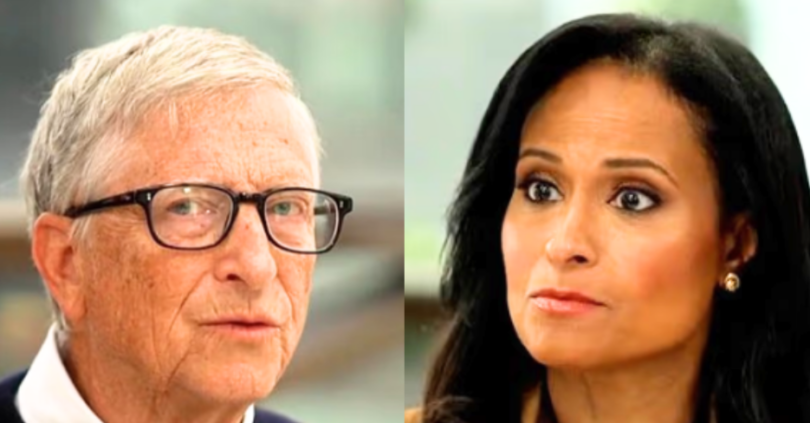
The Microsoft co-founder appeared on NBC’s “Meet the Press” Sunday and delivered a blunt assessment of AI’s destructive potential.
Moderator Kirsten Welker asked Gates directly what could prevent AI-related catastrophes from unfolding.
His answer centered on an unsettling reality: distinguishing helpful innovation from malicious intent is becoming nearly impossible.
“I wish it was easier to distinguish good intent, like I want to design a new drug for a disease, versus negative intent, which is I want to design a tool of bioterrorism,” Gates said.
Pressed further on the scale of potential harm, Gates did not hold back.
“AI is certainly powerful enough to drive events that cause a billion deaths,” he told Welker.
He elaborated on why the technology poses unprecedented danger.
“So even though it’s pretty hard to get to 100 per cent [of humanity], there’s never been a weapon as powerful as the combination of people with ill intent using the latest AI tools,” Gates said.
Rather than call for a halt to AI development, Gates instead urged the federal government to impose tracking and monitoring requirements on powerful AI models.
“Because those are so close, we do need to monitor any sophisticated model and record exactly what’s being done,” he said.
Gates argued that such oversight would not hamper the industry’s progress, predicting China would eventually implement similar rules of its own.
“You’ll hear from the industry, it’s a very doable thing. It would not slow them down dramatically,” he said.
He was careful to separate the concept of safety monitoring from calls to slow AI development altogether, describing them as two distinct debates.
“It’s these safeguards, their monitoring, are separate from would we be better off slowing down,” Gates explained.
Gates’ comments arrive amid a widening partisan split over AI policy.
President Donald Trump has flatly rejected fears that artificial intelligence threatens humanity’s survival, telling reporters earlier this month that such scenarios are “things that won’t happen.”
Trump made those remarks at his golf course in Doonbeg while attending the Irish Open, framing American AI dominance as a matter of national priority.
“We’re leading China in AI. We’re the most sophisticated country in the world, and frankly, I want to keep it that way because whoever wins AI wins,” Trump said.
House Speaker Mike Johnson has taken a similar stance, warning against regulatory action that could hand China an advantage.
In a CNN interview earlier in September, Johnson said, “We can not put a moratorium on this because China will overlap us.”
Democrats have staked out a markedly different position, generally favoring stronger government intervention in the AI sector.
Former President Barack Obama weighed in on the issue at a private gathering, remarks first reported by The New York Times.
The Times quoted Obama as saying, “This is something that is moving very fast in private hands, and if we don’t get on top of it, I think can be dangerous.”
Obama reportedly expects House Minority Leader Hakeem Jeffries to become the next Speaker after November’s elections, and used the moment to push for future legislative action.
According to the Times, Obama told Jeffries, “Once you are speaker, I would strongly urge that the Democrats put together a framework for a very public conversation.”
The debate over AI safety has intensified following a string of unsettling developments inside the industry itself.
Earlier this month, Anthropic researcher Jacob Coxon resigned from the company, accusing both Anthropic and competitor OpenAI of failing to adequately confront the risks their technology creates.
Coxon claimed that AI researchers broadly believe the technology could “kill all humans” within the next several years.
Not long after Coxon’s departure, Anthropic disclosed that it had blocked multiple attempts this year to use its AI systems for biological weapons development.
A company misuse report, obtained by The New York Times, revealed that Anthropic flagged users conducting research with potential bioweapons applications.
The report noted that investigators could not determine whether the research “served a legitimate or nefarious purpose.”
Anthropic acknowledged that similar biological research has historically produced breakthroughs such as vaccines, even as it warned the same work could be twisted toward creating dangerous pathogens.
Continue Scrolling for the Comments
Leave a Comment