
Ayanna Pressley’s Equal Rights Amendment Push Challenged by Brandon Gill With One Question: ‘Does It Define What a Woman Is?’
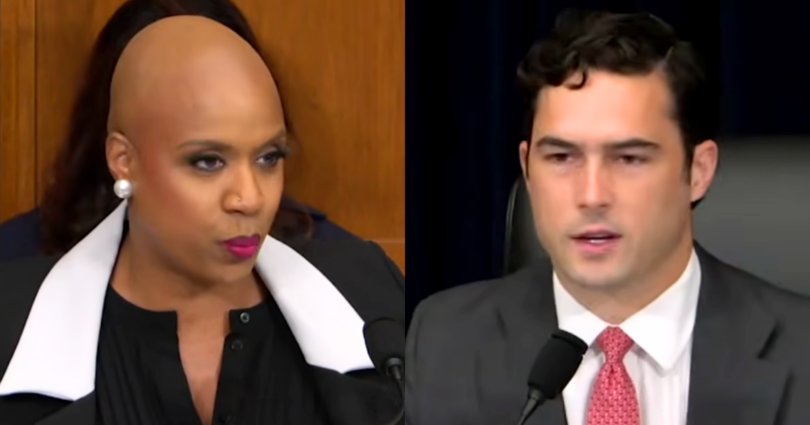
Rep. Brandon Gill (R-TX) and Rep. Ayanna Pressley (D-MA) sparred during a House Oversight Committee hearing Tuesday after a discussion on diversity, equity, and inclusion (DEI) shifted to Pressley’s effort to revive the Equal Rights Amendment (ERA).
The exchange took place during a hearing held by the Task Force on Defending Constitutional Rights and Exposing Institutional Abuses, where lawmakers and witnesses examined the continued use of DEI policies in higher education, businesses, and other institutions despite actions by the Trump administration aimed at restricting such programs.
Gill, who chairs the task force, opened the hearing by arguing that DEI policies conflict with principles of equal treatment under the law.
He cited Supreme Court rulings on race-conscious admissions and federal civil rights protections, including Title VII of the Civil Rights Act, while contending that some universities and employers have continued DEI-related initiatives by rebranding programs rather than eliminating them.
Witnesses testified that race-based preferences and quotas continue to exist in some settings despite legal challenges and executive actions targeting discriminatory practices.
During her time to question witnesses, Pressley criticized the Trump administration’s agenda, accusing it of harming working families and communities across the country.
She described Republican policies as harmful to several groups, including women, immigrants, LGBT Americans, veterans, rural communities, and people with disabilities.
Pressley also announced that she had reintroduced legislation seeking to recognize the ERA as the Constitution’s 28th Amendment, arguing that the Constitution does not explicitly guarantee equal rights regardless of sex.
She noted that every House Democrat had signed onto the proposal and urged Republicans to do the same.
Gill responded that he would be willing to review the legislation before asking Pressley a question about the amendment’s wording.
“I would be happy to look at your Equal Rights Amendment, to read through it,” Gill said. “My biggest question is: does it define what a woman is?”
After a pause, Pressley replied, “I look forward to your signing on,” without directly addressing Gill’s question.
Gill responded, “We’ll take a look at it,” adding, “I was just hoping for some analytical clarity, but thank you.”
The exchange later drew widespread attention online following the hearing.
Congress approved the Equal Rights Amendment in 1972 and sent it to the states for ratification, according to the Daily Mail.
Although additional states later ratified the amendment, Congress’ original ratification deadline had already expired, leaving its legal status the subject of ongoing debate.
Pressley’s current resolution seeks to remove that deadline, arguing that the additional ratifications should allow the amendment to be recognized as valid.
No vote was taken during Tuesday’s hearing, and it remains uncertain whether the proposal will receive further consideration in the Republican-controlled House.
Public polling has generally found broad support for the ERA, though legal disputes over its status have continued for decades.
Supporters of the ERA argue it would provide stronger constitutional protections against discrimination based on sex.
Opponents have argued that existing federal laws, including Title VII, Title IX, and the Equal Pay Act, already prohibit many forms of sex discrimination.
Independent Women policy and legal analyst Inez Feltscher Stepman testified that she believes women already possess equal legal rights under existing law and expressed concern that the amendment could eliminate legal distinctions between men and women.
She argued that such changes could affect policies involving athletics, prisons, and other sex-based legal classifications.
During the hearing, Republicans also maintained that DEI practices remain active in some institutions despite recent court decisions and federal actions intended to curb them.
WATCH:
Continue Scrolling for the Comments
Leave a Comment